
UAE’s Autonomous Deep-Space Probe Nears Launch for Historic Asteroid Mission
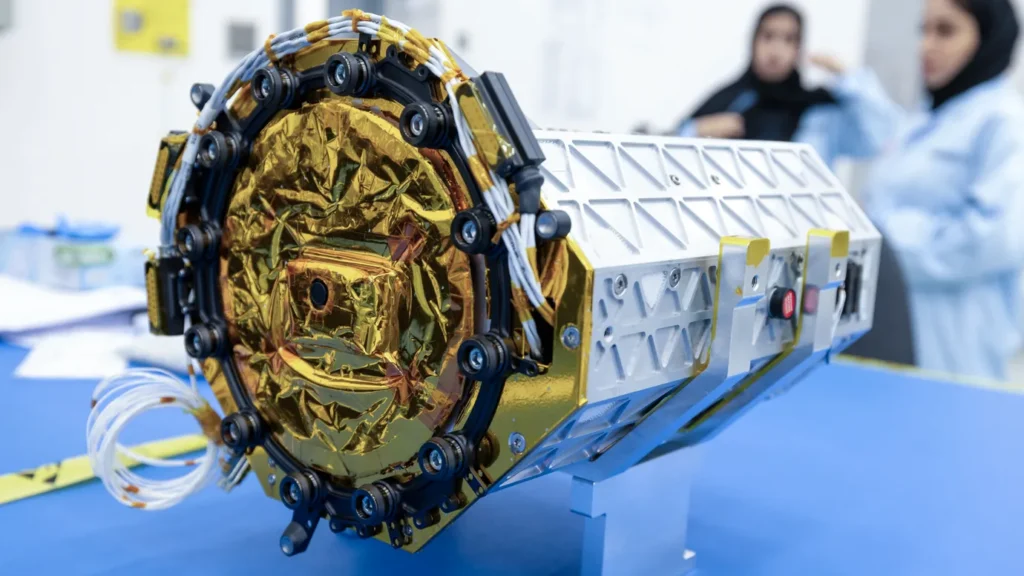
The Technology Innovation Institute has completed development of a sophisticated probe designed to autonomously explore asteroid 269 Justitia, marking a significant milestone in the Emirates Mission to the Asteroid Belt and a demonstration of the UAE's expanding space technology capabilities.
The Technology Innovation Institute (TII) has unveiled the UAE-engineered probe destined for the Emirates Mission to the Asteroid Belt (EMA), a landmark achievement in the nation’s advancing space exploration programme. The probe will imminently travel to Colorado for integration with the MBR Explorer spacecraft ahead of its scheduled 2028 launch from Japan.
This historic endeavour will see the probe image two planets and traverse the main asteroid belt, conducting close encounters with six asteroids before culminating in a landing on 269 Justitia—a feat that would make it only the seventh probe in human history to successfully touch down on an asteroid’s surface.
An Entirely UAE-Built Achievement
Conceived, constructed and rigorously tested entirely within Abu Dhabi, the probe represents a collaborative effort between TII’s Propulsion and Space Research Center, the UAE Space Agency, HEX20, Khalifa University and UAE University’s National Space Science and Technology Center. Serving as the mission’s sole deployable payload, the system will separate from the MBR Explorer to make autonomous contact with 269 Justitia’s surface at the mission’s furthest reach, operating with complete independence in the hostile environment of deep space. Its primary objectives include capturing high-resolution imagery and excavating surface material to illuminate the asteroid’s composition and physical characteristics.
The asteroid 269 Justitia presents a compelling scientific target. Among the reddest bodies yet observed in the main asteroid belt, its spectrum resembles objects found in the Kuiper Belt beyond Neptune rather than neighbouring asteroids, suggesting it originated in the cold outer Solar System before migrating inward during the early formation of the planets. Its surface is believed to harbour complex organic material produced by the irradiation of frozen substances—material otherwise accessible only through a decade-long voyage to the distant Kuiper Belt itself.
Engineering for Extreme Conditions
The probe’s technical sophistication centres on its capacity for complete autonomous operation, making independent decisions billions of kilometres from Earth. Throughout its eight-year journey, the system will determine when to image, how many frames to capture, and which are scientifically worthwhile—capabilities enabled by a custom digital processing unit designed by TII that manages imaging selection, data processing and power management. Two cameras, one wide-field and one narrow-field, will capture both contextual and high-resolution observations, transmitting data back to Earth at approximately six-month intervals.
His Excellency Faisal Al Bannai, Secretary General at the Advanced Technology Research Council and Member of the UAE Supreme Space Council, underscored the strategic significance: “If you want to build serious technological capability, you take on a problem that forces you to push further. For this mission, that means a probe that must make decisions and operate on its own in deep space. And our teams have built that technology here in the UAE.”
The MBR Explorer will traverse approximately 5 billion kilometres over eight years, executing gravity-assist manoeuvres at Venus, Earth and Mars whilst conducting close encounters with six asteroids before reaching 269 Justitia. Because the parent spacecraft cannot safely approach within several kilometres of the asteroid’s surface, the probe will deploy during a low-altitude orbital pass in early 2036, descending to make contact and capturing continuous imagery whilst transmitting data to the orbiting spacecraft above.
Building National Capability
Dr Najwa Aaraj, Chief Executive Officer of TII, emphasised the broader implications: “EMA Probe demonstrates what becomes possible when advanced research is translated into mission-ready engineering. Our teams at TII have developed a system designed to withstand extreme conditions, operate with exceptional precision, and deliver meaningful science billions of kilometres from Earth.”
The Emirates Mission to the Asteroid Belt represents the UAE’s second interplanetary mission and the first in which the spacecraft element has been designed, engineered, assembled and tested within the country. This achievement aligns with a broader national commitment to space exploration. In May 2026, the Supreme Space Council approved an AED1 billion International Space Cooperation Program intended to establish connections between UAE research institutions and international counterparts, localise advanced space technologies, and cultivate Emirati talent in support of the National Space Strategy 2031.
Source: Abu Dhabi Media Office