
MBRSC and UNOOSA Launch Third Round of Payload Hosting Initiative Applications
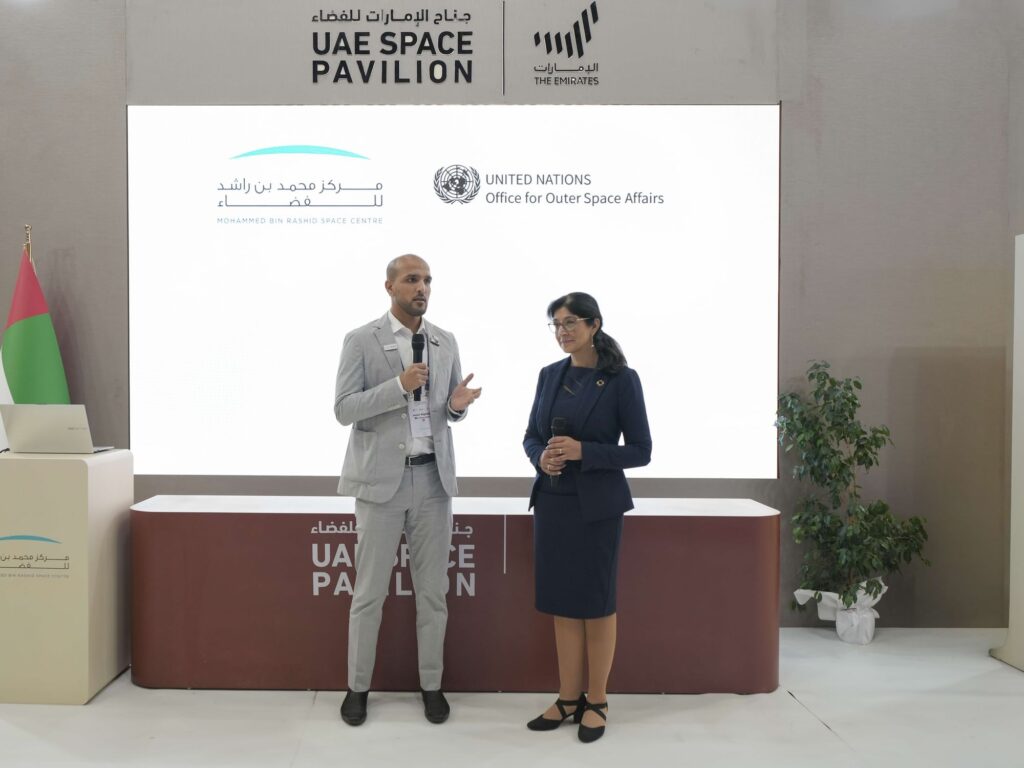
The Mohammed Bin Rashid Space Centre and United Nations Office for Outer Space Affairs have opened applications for PHI-3, expanding opportunities for nations and organisations to participate in cutting-edge space missions through innovative payload hosting.
The Mohammed Bin Rashid Space Centre (MBRSC) and the United Nations Office for Outer Space Affairs (UNOOSA) have announced the opening of applications for PHI-3, the third opportunity under the Payload Hosting Initiative, marking a significant expansion of international participation in space exploration and technological innovation.
The announcement was made during the 77th International Astronautical Congress in Antalya, Türkiye, underscoring the global significance of this collaborative endeavour. The Payload Hosting Initiative represents a joint partnership between MBRSC and UNOOSA’s ‘Access to Space for All’ initiative, designed to cultivate practical space capabilities across nations through experiential learning opportunities.
Through this distinguished programme, MBRSC develops and provides a 12U CubeSat platform capable of hosting innovative payloads and emerging space technologies from around the world. Participating entities gain the invaluable opportunity to test and validate their technologies in orbit whilst engaging in a genuine space mission, benefiting from MBRSC’s sophisticated technical and operational expertise.
Amer AlSayegh AlGhaferi, Assistant Director General of the Aerospace Engineering Sector at MBRSC, expressed the Centre’s commitment to democratising space access. He emphasised that the initiative reflects a shared vision with UNOOSA to expand participation in space exploration and create meaningful opportunities for emerging space entities and nations to engage directly in authentic missions. By merging MBRSC’s satellite development capabilities with UNOOSA’s international capacity-building framework, the programme establishes a pathway for innovative ideas, technologies and emerging talent to reach orbit.
Aarti Holla-Maini, Director of UNOOSA, highlighted that access to space transcends merely reaching orbit, emphasising instead the development of essential skills, experience and confidence that enable institutions to cultivate their own space capabilities. She encouraged teams from nations yet to access space to apply for PHI-3.
The third mission continues the programme’s focus on providing an inclusive platform for testing, collaboration and innovation, welcoming companies, universities, research centres and emerging space entities to contribute meaningfully to the global space ecosystem. The initiative facilitates comprehensive knowledge exchange across satellite design, manufacturing, testing, launch operations and sophisticated data analysis.
The inaugural satellite under the initiative, PHI-1, was successfully launched in November 2025, carrying payloads from the Bahrain Space Agency, Antarikchya Pratisthan Nepal, Sharjah Space and Astronomy Hub and MBRSC itself. For PHI-2, the Technical University of Moldova and Madari Space Limited of the UAE were selected to launch their payloads into space.
Applications for PHI-3 will remain open until 6 April 2027, with proposals to be evaluated jointly by MBRSC and UNOOSA. Selected awardees are expected to be announced in the final quarter of 2027.
Source: WAM