
UAE Leads Arab Nations in Digital Economy Performance
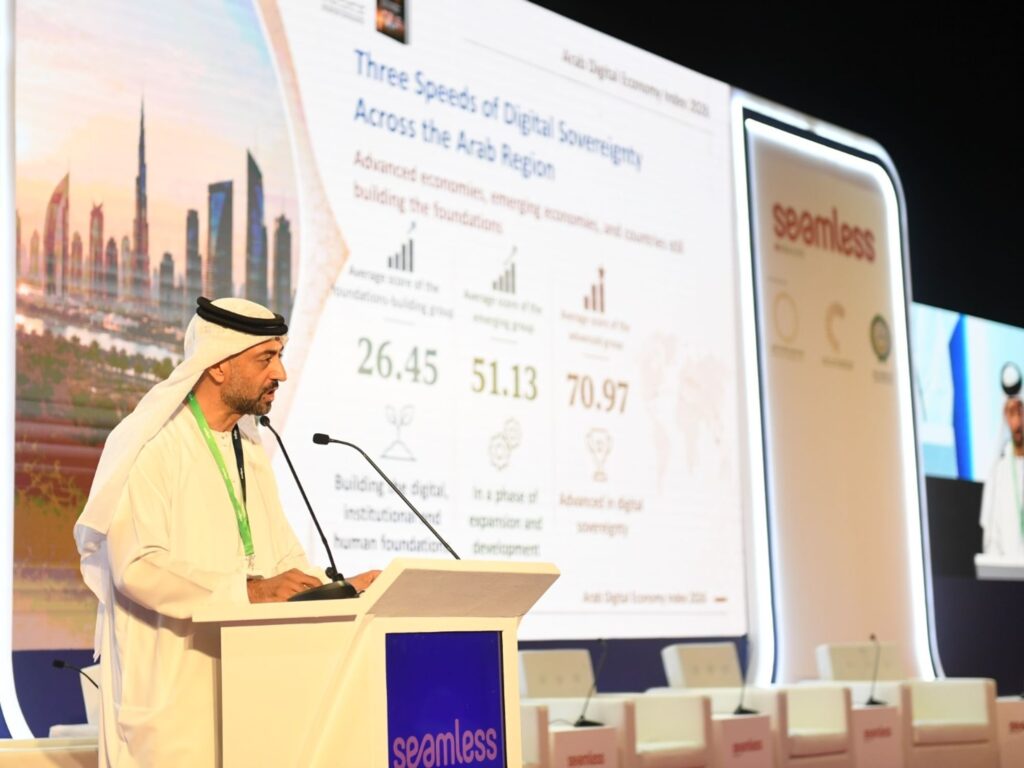
The Emirates has secured top ranking in the Arab Digital Economy Index 2026, reflecting sustained investment in digital infrastructure, innovation and technological advancement across government and economic sectors.
The United Arab Emirates has claimed the leading position in the Arab Digital Economy Index 2026, with results unveiled at the opening of Seamless Middle East 2026 in Dubai this week. The prestigious conference, held at Dubai World Trade Centre from 22nd to 24th September, operates under the patronage of H.H. Lt. General Sheikh Saif bin Zayed Al Nahyan, Deputy Prime Minister and Minister of the Interior.
The index evaluates digital-economy performance across nine key dimensions: institutional frameworks, infrastructure capabilities, workforce development, digital government services, innovation ecosystems, knowledge and technology advancement, market dynamics, capital-market expansion and sustainable development objectives. The UAE’s comprehensive excellence across these areas distinguishes it within the Arab region.
The assessment categorises Arab nations into three performance tiers. Alongside the UAE, the highest-performing group encompasses Saudi Arabia, Bahrain, Qatar and Oman. A second cohort of medium-performance countries includes Jordan, Kuwait, Morocco, Egypt, Tunisia and Algeria. Nations currently developing their digital foundations comprise Lebanon, Mauritania, Iraq, Djibouti, Comoros, Libya, Palestine, Syria, Sudan, Somalia and Yemen.
Dr. Ali Mohammed Al-Khouri, Chairman of the Arab Federation for Digital Economy, attributed the Emirates’ success to years of methodical investment in digital infrastructure, government digitalisation, cybersecurity capabilities, artificial intelligence applications and the knowledge economy. He highlighted how the nation has established itself as a leading exemplar for developing innovation-driven economies that effectively convert technological progress into enhanced productivity and measurable economic value.
The broader analysis reveals strengthened Arab-wide progress in digital infrastructure, government service digitalisation and cybersecurity resilience. However, notable gaps persist in innovation capacity, data economy development, research and development investment, and the translation of digital expenditure into tangible productivity gains.
The event convened over 25,000 participants alongside approximately 800 speakers and 750 exhibitors, attracting senior diplomatic, governmental and institutional representatives from across the Arab world and beyond. The three-day conference programme encompasses extensive deliberations on fintech innovations, digital payments infrastructure, e-commerce transformation, artificial intelligence deployment, data analytics advancement, cybersecurity strategies and emerging technological frontiers.
The Arab Digital Economy Vision, originally launched in Abu Dhabi in 2018 with the support of President His Highness Sheikh Mohamed bin Zayed Al Nahyan, received formal adoption at the Arab leaders’ level in 2022 as a comprehensive framework for regional cooperation in digital economy development and technological transformation.
Source: WAM