
Youth Council Explores Digital Age Crime Prevention at UN Congress
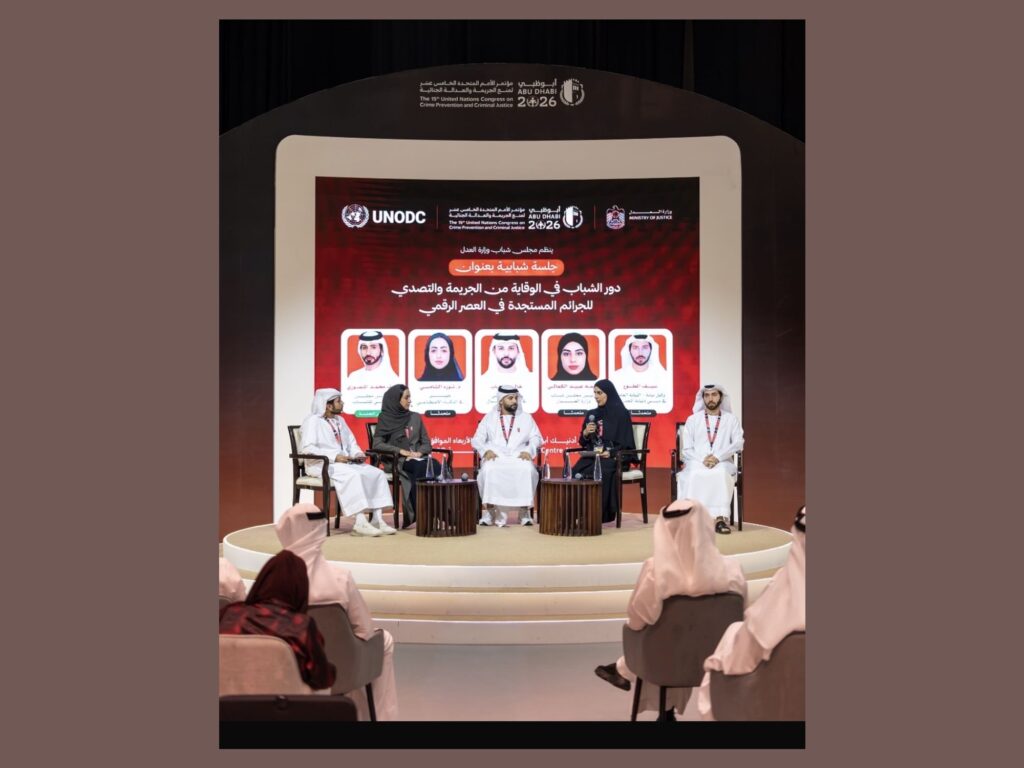
The Ministry of Justice's Youth Council has convened a pivotal session addressing the critical intersection of youth engagement, emerging digital threats and justice system innovation at the 15th United Nations Congress on Crime Prevention and Criminal Justice in Abu Dhabi.
The Youth Council of the Ministry of Justice has brought together leading experts and practitioners to examine how young people can meaningfully contribute to crime prevention in an increasingly complex digital landscape. Speaking at a dedicated session during the 15th United Nations Congress on Crime Prevention and Criminal Justice – Abu Dhabi 2026, prominent figures from across the justice sector outlined both the challenges and opportunities presented by technological advancement.
Dr Noora Alshamsi, an artificial intelligence expert, highlighted how digital crime has evolved dramatically through technological innovation. She observed that artificial intelligence systems now possess the capability to replicate voices and generate convincing visual content within moments, fundamentally altering both the nature and velocity of criminal activity. Rather than focusing solely on risk awareness, Dr Alshamsi advocated for a more sophisticated approach centred on developing young people’s comprehension of AI technologies and their capacity to recognise deceptive content and anticipate emerging threats.
Khaled Diab, Legal Researcher at the Ministry of Justice, illustrated practical dimensions of contemporary fraud, demonstrating how voice-cloning and deceptive messaging can be weaponised to impersonate trusted figures and solicit unauthorised financial transfers. He emphasised that crime prevention requires broader societal participation beyond institutional frameworks, positioning the Congress itself as a demonstration of youth empowerment in contributing recommendations and knowledge-sharing to justice system development.
Basma Obaid Alkamali, Chairman of the Youth Council at the Ministry of Justice, underscored young people’s pivotal role in driving innovation within justice systems. She noted their technical proficiency and capacity to leverage technology and artificial intelligence in streamlining procedures and enhancing operational efficiency. Ms Alkamali stressed that such innovation must remain anchored in legal and human-centred principles, encouraging young people to advance solutions responsive to evolving societal needs.
Saif Al Muttawa, Public Prosecutor at the Dubai Public Prosecution’s Narcotics Prosecution, addressed the transformation of drug trafficking methodologies, emphasising how illicit substances are now marketed to young people through seemingly innocuous products and social media channels. He cautioned against complacency and advocated for vigilance in product verification and avoidance of unauthorised suppliers.
The session, moderated by Saif Almansoori, Chairman of the Abu Dhabi Youth Council, reflected the United Arab Emirates’ commitment to positioning young people as active stakeholders in strengthening legal frameworks and digital literacy within society.
Source: WAM