
Central Bank of UAE Convenes Second Annual Climate Forum Amid Regional Leadership in Green Finance
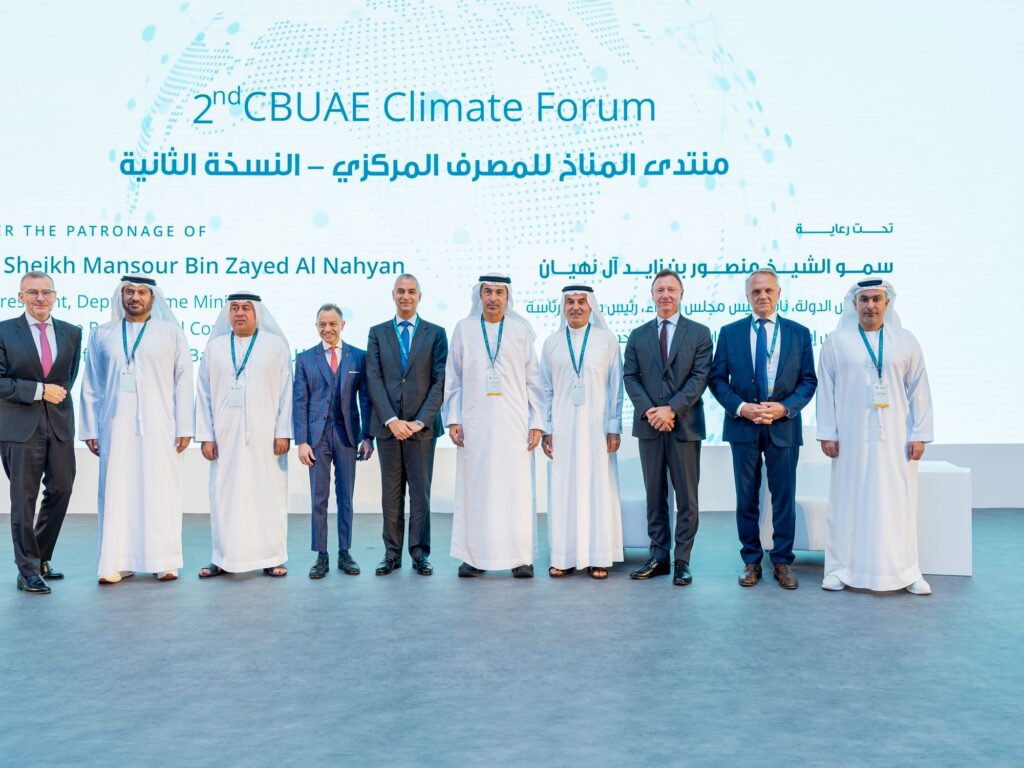
The CBUAE's second consecutive Climate Forum brings together policymakers, central bankers and financial leaders to advance sustainable finance and climate resilience across the region.
Abu Dhabi has welcomed the second annual Climate Forum, organised by the Central Bank of the United Arab Emirates under the patronage of His Highness Sheikh Mansour Bin Zayed Al Nahyan, Vice President, Deputy Prime Minister and Chairman of the Presidential Court. The Forum, held on 8-9 October 2026, represents a significant platform for advancing the financial sector’s role in supporting sustainability and climate action at regional and international levels.
The gathering brings together leading policymakers, central bank officials and financial sector leaders, alongside international experts in climate finance and financial stability. Discussions focus on climate change’s implications for monetary policy and financial resilience, alongside the critical role of sustainable finance in transitioning to a low-carbon, climate-resilient economy.
His Excellency Khaled Mohamed Balama, Governor of the CBUAE, emphasised the institution’s commitment to translating the vision of the UAE’s wise leadership into concrete initiatives with measurable impact. The Governor outlined key climate-related initiatives, including preparations for climate risk stress testing, enhanced sustainability management of foreign reserves, and implementation of Climate-related Financial Risk Management Regulations.
The CBUAE’s sustainable bond holdings represent approximately 5 per cent of its foreign reserves, which stood at US$257 billion at the end of September. Notably, the bank’s Sustainable sukuk framework has enabled banks to refinance over US$100 billion of sustainable assets, demonstrating the practical application of green finance instruments.
In a significant regional distinction, the CBUAE serves as co-chair of the Network for Greening the Financial System Workstream on Central Bank Operations—making it the first central bank in the MENA region to hold this prestigious role. This reflects the UAE’s leadership position within a network comprising more than 140 central banks and financial supervisors worldwide.
The Forum’s substantive agenda addressed the evolving relationship between climate risk, financial stability and monetary policy, including the potential for climate-related risks to remain insufficiently priced in financial markets. Panel discussions explored sustainable finance’s capacity to mobilise capital for net-zero transition, with emphasis on emerging opportunities in the blue economy and innovative green financial products.
Digitalisation and financial innovation emerged as critical enablers of accessible, scalable sustainable finance solutions. Participants examined technology’s role in supporting efficient payment and settlement systems aligned with green economy requirements.
His Excellency Khalid Ibrahim Humaidan, Governor of the Central Bank of Bahrain, highlighted the essential nature of regional cooperation and knowledge-sharing in strengthening central banks’ understanding and management of climate-related financial risks.
The Forum programme extends to 9 October with the inaugural Climate Research Seminar, developed in collaboration with the Centre for Economic Transition Expertise at the London School of Economics. This seminar convenes researchers, policymakers and financial sector experts to examine climate risk modelling developments, sustainable investment practices and policy approaches to net-zero transition challenges.
Source: WAM News Agency